
How AI Is Changing Your Next Dental Visit: What Canadian Patients Should Know in 2026
If you have visited a dental office in the last year, your X-rays may have been reviewed by more than just your dentist. Artificial intelligence has moved out of research labs and into everyday Canadian dental practices, where it now helps clinicians spot cavities, gum disease, and bone loss earlier than ever before.
Key Takeaways
- Artificial intelligence is now widely used in Canadian dental clinics to analyze X-rays, flag early decay, and assist with treatment planning.
- AI-assisted cavity detection can identify lesions that are easy to miss on traditional X-rays, often catching problems at a remineralizable stage.
- AI does not replace your dentist — it acts as a second set of eyes that supports a more accurate diagnosis.
- Patients benefit from shorter appointments, clearer visual explanations, and earlier, less invasive treatments.
- Ask your dental clinic whether they use AI imaging tools and how those tools support your care.
A Quiet Revolution in the Dental Chair
This shift is one of the biggest changes in dentistry in decades. According to industry analysts, AI-powered imaging is becoming a standard feature in technologically advanced clinics across Canada in 2026, alongside other tools like 3D printing and digital impressions. For patients, that means a faster, clearer, and often less invasive experience.
How AI Actually Works in a Dental Clinic
AI in dentistry is built on a technology called a convolutional neural network, which is trained on thousands of dental X-rays labelled by experienced dentists. Once trained, the software can analyze a new radiograph in seconds and highlight areas of concern.
Here is what AI is typically used for inside the clinic:
- X-ray analysis to detect cavities, bone loss, and early infections
- Periodontal monitoring with colour-coded measurements of bone levels around teeth
- Treatment planning for implants, orthodontics, and root canals
- Risk assessment for issues such as oral cancer and gum disease
- Workflow automation for scheduling, recalls, and patient reminders
Why This Matters for Cavity Detection
Traditional X-ray interpretation has limits. Shadows, overlapping teeth, and small early lesions can be difficult to read, even for experienced clinicians. Studies show AI tools can dramatically improve sensitivity, flagging early decay that human eyes commonly miss.
Some commercial systems used in Canada report that clinicians using AI miss roughly 43% fewer cavities and produce around 15% fewer false positives compared with X-ray review alone. Catching decay early matters because small lesions can often be reversed or treated with minimally invasive care — the same principle behind strengthening enamel through remineralization.
AI Does Not Replace Your Dentist
This is the most important point to understand. AI is a decision-support tool, not a diagnosis. The software highlights areas that look suspicious; your dentist interprets the findings in context — considering your medical history, symptoms, and clinical examination.
Used this way, AI supports more consistent care between providers and between visits. Two dentists looking at the same X-ray can sometimes disagree on whether a shadow is decay. An AI tool offers a neutral second opinion that helps reduce that variation and keeps your records more objective over time.
Real Benefits Patients Are Already Noticing
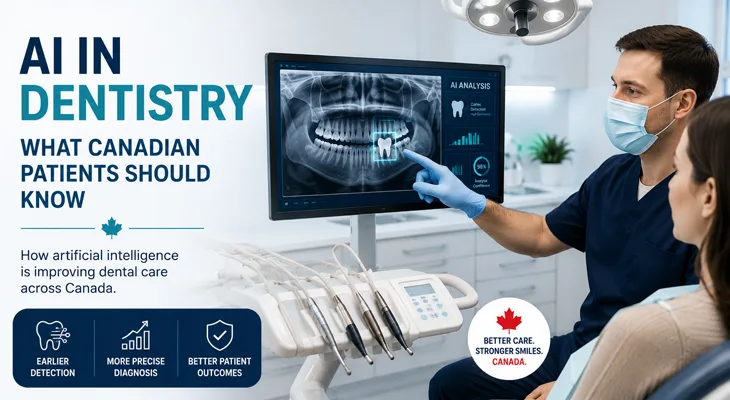
Patients in Canadian clinics using AI tools report a noticeably different experience compared with a traditional checkup. The technology often shows up on the screen beside the dental chair, with colour-coded overlays that make findings easier to understand.
Common patient-facing benefits include:
- Visual explanations — you can see exactly where a problem is, instead of relying on a verbal description
- Earlier interventions — small problems are caught before they require crowns or root canals
- Lower long-term costs — early fillings are far cheaper than complex restorations
- Less anxiety — clear visuals build trust and make the routine dental appointment feel more transparent
- Faster follow-ups — automated systems help clinics confirm appointments and send recalls on time
What This Means in the Context of the Canadian Dental Care Plan
The rollout of the Canadian Dental Care Plan has brought millions of new patients into clinics across the country. You can read about the program directly on the Government of Canada’s oral health page. With more patients to see, clinics are under real pressure to deliver care efficiently without sacrificing accuracy.
AI tools help meet that demand in two ways. They speed up X-ray review, freeing up clinical time, and they help newer practitioners maintain consistent diagnostic quality. For patients, this can translate into shorter wait times for appointments and more confidence that issues will not be missed.
What to Ask at Your Next Appointment
If you are curious about how AI might be involved in your care, it is completely reasonable to ask. A good dental team will be happy to explain what tools they use and what the technology can and cannot do.
Questions worth asking include:
- Does this clinic use AI to analyze X-rays or scans?
- Can I see the AI-annotated images of my own teeth?
- How does your dentist use the AI findings in the final diagnosis?
- Are my images stored securely, and who has access to them?
Combined with strong daily habits like brushing, flossing, and following good oral hygiene practices, AI-assisted care can help you keep your teeth healthier for longer with fewer surprises along the way.
The Bottom Line
AI is not about replacing the human side of dentistry. It is about giving your dental team better information so they can give you better care. As more Canadian clinics adopt these tools through 2026 and beyond, expect your dental visits to become faster, more visual, and more focused on prevention. The technology is already here — and it is quietly working in your favour every time you sit in the chair.