
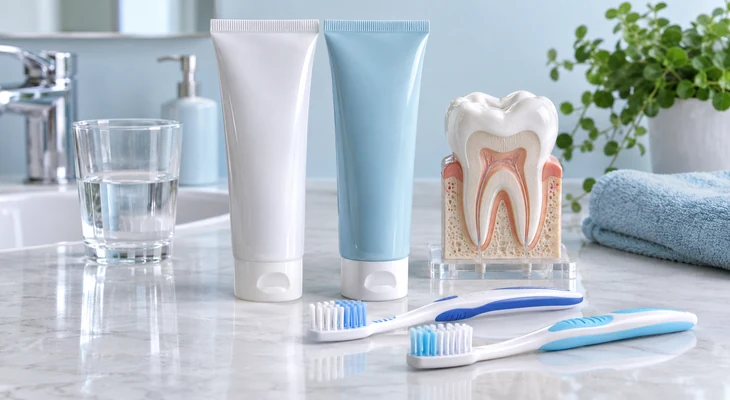
Nano-Hydroxyapatite Toothpaste vs Fluoride: Which Is Better?
Walk down the toothpaste aisle or scroll through wellness influencers’ feeds and you’ll start seeing a new ingredient everywhere: nano-hydroxyapatite. It’s often marketed as a natural, fluoride-free way to repair enamel. Some people swear by it, while others wonder if it’s just the latest trend. So how does it really compare with fluoride, the ingredient dentists have recommended for decades? Let’s break it down in plain language.
Key Takeaways
- Nano-hydroxyapatite (nano-HA) is a lab-made version of the mineral that makes up most of your enamel.
- Both fluoride and nano-HA help strengthen enamel through a process called remineralization.
- Fluoride has decades of strong evidence behind it and remains the standard recommendation in Canada.
- Early research on nano-HA is promising, and it may help with sensitivity.
- The best toothpaste is one you use twice a day, and your dentist can help you choose based on your cavity risk.
How Your Enamel Repairs Itself
Your enamel is constantly going through a cycle of losing and regaining minerals. Every time you eat or drink something sugary or acidic, bacteria and acids pull minerals out of the enamel. This is called demineralization. Between meals, saliva helps put minerals back. That’s remineralization.
When the balance tips too far toward mineral loss, you get weak spots, white chalky marks and eventually cavities. Both fluoride and nano-HA work by helping your teeth win that tug of war. For a deeper look at this process, read our guide on how to strengthen tooth enamel through remineralization.
What Is Fluoride and How Does It Work?
Fluoride is a natural mineral. When it’s in your mouth, it does a few things:
- It combines with your enamel to form a tougher surface that resists acid better than natural enamel.
- It speeds up remineralization, helping repair early damage.
- It makes it harder for cavity-causing bacteria to produce acid.
Fluoride toothpaste has been studied for more than 60 years, and the evidence that it prevents cavities is very strong. Community water fluoridation is also considered one of the most effective public health measures for oral health. The Government of Canada’s fluoridation fact sheet explains why health authorities continue to support it.
At the levels found in toothpaste and drinking water, fluoride is considered safe. The main concern is young children swallowing too much toothpaste, which can cause faint white spots on developing teeth, called dental fluorosis. That’s why kids under three should use only a smear of toothpaste, and children three to six a pea-sized amount.
What Is Nano-Hydroxyapatite?
Hydroxyapatite is the main mineral in your teeth and bones. About 97 percent of your enamel is made of it. Nano-hydroxyapatite is a synthetic version made into extremely tiny particles, small enough to fill in microscopic gaps and weak spots on the enamel surface.
It was first developed for dental use in the 1970s and has been used in toothpastes in Japan for decades. Instead of creating a new protective layer like fluoride does, nano-HA works by directly depositing building blocks of enamel back into the tooth.
Supporters like that it’s biocompatible, meaning it’s the same material your body already makes, and that it’s safe if swallowed. That makes it appealing for parents of young children and people who prefer to avoid fluoride.
What Does the Research Say?
Here’s an honest look at where the evidence stands:
- Cavity prevention: Some clinical trials have found that toothpaste with 10 percent nano-HA performed about as well as fluoride toothpaste at preventing cavities. But there are far fewer studies, and many are small or short-term.
- Sensitivity: Nano-HA appears to help reduce tooth sensitivity by plugging the tiny tubes in exposed dentin. This is one area where it shows real promise.
- Whitening and smoothness: Some users notice smoother, slightly brighter-looking teeth because nano-HA fills tiny surface scratches.
- Long-term data: Fluoride still has a much larger body of research, especially for people at high risk of cavities.
Nano-HA vs Fluoride: Side-by-Side
Choose Fluoride If…
- You get cavities often or have a lot of fillings
- You have dry mouth, braces or exposed roots
- You want the option with the strongest proof behind it
Nano-HA May Be Worth Considering If…
- You have sensitive teeth and want extra relief
- You have a young child who tends to swallow toothpaste (ask your dentist first)
- You prefer a fluoride-free option and have a low risk of cavities
Some people use both, such as a fluoride toothpaste in the morning and a nano-HA paste at night. If sensitivity is your main concern, our article on sensitive teeth covers other causes and fixes.
Tips for Choosing a Toothpaste
- Look for a nano-HA concentration of about 10 percent, the level used in most studies.
- Be cautious of “natural” toothpastes that contain neither fluoride nor nano-HA, as they may not protect against cavities.
- Avoid highly abrasive charcoal pastes that can wear down enamel.
- Don’t rinse right after brushing. Spit out the excess and let the active ingredient keep working.
So, Which Is Better?
For most Canadians, fluoride toothpaste is still the gold standard, backed by decades of research. Nano-hydroxyapatite is a promising alternative, especially for sensitivity and for people who want to avoid fluoride, but the research is still catching up.
The right choice depends on your cavity risk, your age and your goals. Ask your dentist at your next visit. If you need a new dental home, find a dentist in your city on Canada Dental Network.
Tags: Enamel, Fluoride, Nano-Hydroxyapatite, Toothpaste